1 The Basic Concepts and Connotations of Intelligent Process Design
1) Basic Concepts of Intelligent Process Design
Process design is one of the primary tasks of the technical department in manufacturing enterprises. Its quality and efficiency significantly impact production organization, product quality, cost, productivity, and production cycle. As a highly complex task, process design encompasses various functional requirements with different natures, such as analysis, selection, planning, and optimization. It involves extensive knowledge and information, closely correlates with specific production environments (e.g., air humidity, ambient temperature, equipment automation levels), and heavily relies on experiential knowledge. The connotation of process design (Figure 1) can be summarized as follows: ① A decision-making process that considers all conditions/constraints in formulating process plans, involving diverse decisions; ② An activity that integrates manufacturing process knowledge with specific designs under the constraints of workshop or factory resources, preparing detailed operational instructions; ③ A bridge connecting product design and manufacturing.
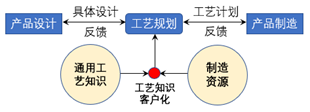
Figure 1 The Fundamental Connotation of Process Planning—The Bridge and Link Between Design and Manufacturing
Computer-Aided Process Planning (CAPP) is a technology where process engineers utilize information technology, computer technology, and intelligent systems to transform product design data into manufacturing data. Its key features include: reducing repetitive and tedious tasks for process designers, allowing them to focus on the development of new products, technologies, and processes; enhancing process inheritance to maximize the utilization of existing resources, thereby lowering production costs; and enabling less experienced process planners to generate high-quality process solutions, alleviating the heavy workload in manufacturing design.
With the continuous maturation of computer software and hardware technology, the theories and methods of computer-aided process planning have achieved a qualitative leap. Applying artificial intelligence theory to computer-aided process planning is one of the newly emerging research hotspots and also a modern development trend in process design. It not only transfers research achievements from the field of artificial intelligence to computer-aided process planning but also expands the application scope of artificial intelligence, achieving a perfect integration of both and promoting their joint development.
Intelligent process design must fully encompass two aspects on the basis of traditional CAPP definitions: first, the explicit, procedural, and modularization of the process design workflow; second, the intelligent and closed-loop nature of process design activities. Combining the concept of traditional computer-aided design, intelligent process design can be summarized as follows: creating a virtual entity of the process design process in a digital manner, utilizing technologies such as intelligent sensing, cloud computing, big data processing, and the Internet of Things to perceive historical and real-time process design data and knowledge. With the support of computer software, hardware, and infrastructure, it simulates, verifies, predicts, decides, and controls the design process through functions like numerical computation, logical judgment, simulation, and reasoning. This forms a closed-loop of "data perception-real-time analysis-intelligent decision-making-precise execution" for the entire design process from raw material to finished product, ultimately achieving intelligent, real-time, explicit, procedural, modular, and closed-loop process design.
2) The connotation of intelligent process design
In the field of mechanical manufacturing, the application of computer technology is very common. In the process of development and progress, computer-aided design (CAD) and computer-aided manufacturing (CAM), which originally existed independently of each other, gradually merged. Computer aided process planning emerged in the effective integration of the two. The traditional computer-aided process planning technology has the following functions: firstly, inputting effective design parameters into the computer; Secondly, determine the process flow, basic procedures, and related tools used in the mechanical manufacturing process; Thirdly, clarify the cutting parameters in mechanical manufacturing; Fourth, calculate the amount of capital investment and usage time for mechanical manufacturing; Fifth, present relevant design data, etc. Intelligent process design is the result of the transformation from the traditional experience based design pattern to the scientific design pattern based on modeling and simulation. The combination of virtual prototyping technology and system simulation methods can not only leverage the predictive capabilities of simulation tools, but also integrate the experience of process personnel into the simulation process for various simulation analysis activities in the process design.
The core goal of intelligent process design is to achieve process digitization, production flexibility, process visualization, information integration, and decision-making autonomy. It revolves around intelligent devices, intelligent design, intelligent manufacturing, and data integration platforms based on the Internet of Things for process design. Its basic functional system and technology can be expressed as:
(1) Control module. The control module, also known as the system main control module, is responsible for integrating other modules of the system, providing external access interfaces, and completing effective communication and transmission of information between various modules.
(2) Product data management module. The input of part information generally includes basic dimensions, geometric topology information, material elements, and technical requirements information.
(3) Process design module. Process design is the core module of the system, which mainly completes case-based reasoning based process design, including part feature coding, process instance library retrieval, extraction of similar process modifications, and editing functions. In the process of process design, the system can call the resource library at any time to query database information such as machine tools, fixtures, cutting tools, measuring tools, etc., which is convenient for quickly obtaining process design results that meet processing requirements and adapt to actual production based on the existing resource situation of the enterprise.
(4) Intelligent decision-making optimization of process technology. Process decision-making includes generating process cards, calculating dimensions between processes, and generating process diagrams; Design the content of the work steps, determine the cutting parameters, and provide the tool position files required to form NC machining control instructions; Design process parameters and provide optimal process parameters based on intelligent algorithms.
(5) Process management module. Submitting the prepared process for review is an effective mechanism to ensure that the process information put into production is appropriate, and implementing online process review is an important part of intelligent process design. Usually, process review consists of four steps: review, standardization, countersignature, and approval, each completed by different users.
(6) Process document management and output module. The ultimate goal of intelligent process design is to obtain process documents that can guide industrial production, therefore, process document output is an indispensable part of intelligent process design. Due to the fact that process documents mainly consist of process flow cards, operation cards, and step cards, selecting or customizing appropriate report output tools is the function of the process document output module.
2 The demand for intelligent process design
1) Analysis of Requirements for Intelligent Process Design
Process design is an important part of product development and serves as a link between product design and manufacturing. The process documents generated by it are an important basis for guiding the production process and formulating production plans. Process design has a significant impact on coordinating production, ensuring product quality, reducing production costs, improving product productivity, and shortening production time for enterprises. Therefore, process design is an important task in production and manufacturing.
Process design requires analyzing and processing a considerable amount of data, not only considering the structural shape, materials, dimensions, production, and other data of the designed parts, but also understanding the processing methods, equipment, conditions, and costs during the manufacturing process. The relationships between these process data are complex and intricate, and when process personnel design process plans, they must comprehensively and carefully analyze and process these process data. Throughout the years, the design method of process schemes has relied on the technology and experience accumulated by process engineers in the production activities of enterprises, and is carried out manually. The quality of process schemes basically depends on the level of process engineers themselves. There are common issues of repetition and diversity in process design. With the manufacturing industry entering the era of informatization and knowledge economy, the production of mechanical parts products is now dominated by multi variety and small batch production. Traditional process design methods are no longer able to meet the needs of industry development, as shown in:
(1) Relying on manual craftsmanship for process design is labor-intensive, extremely inefficient, and subjectively flexible. According to relevant data statistics, mechanical parts have a similarity of 70% to 80%, and the process routes of similar parts also have certain similarities. Effective practical work in process design may only account for about 8% of the total work time, and many enterprises use about 55% of the process preparation time for process data calculation, copying, and other repetitive tasks. In the process of process design, process engineers need to spend a lot of work time on repetitive copying of process parameters, process content, and process data, which increases their workload and leaves them with no extra time for creative work such as optimizing process plans. This prolongs the time for process design and affects the entire product production cycle. Manual craftsmanship design is difficult to achieve optimal and standardized solutions, which can easily lead to waste of resources such as manpower, equipment, and energy, and increase the manufacturing cost of products.
(2) The manufacturability of the product is difficult to evaluate, and the process design and verification methods are outdated. Most manufacturing enterprises still use two-dimensional process cards with textual descriptions for process plan design. It is difficult to intuitively understand the current situation of process equipment and devices during process plan design. Process design cannot be simulated and analyzed, making it difficult to evaluate existing process plans. Process information is stored on paper cards, which are difficult to store and easily lost, making it difficult to disseminate and reuse on a large scale.
(3) Lack of effective management of process data. Traditional process design uses paper archives, which makes it difficult to reuse and effectively manage existing process data. How to extract typical processes from existing process documents, make more effective use of process data resources, and better inherit the company's accumulated process experience over the years are important issues that urgently need to be solved. The accumulation of knowledge and experience by process engineers is relatively slow, and the technical personnel in enterprises have a high degree of mobility. After they resign or retire, the knowledge and experience accumulated by engineers in process development work cannot be well preserved. Newly hired process engineers in enterprises need to start learning process knowledge and experience from scratch, which to some extent causes a huge loss of knowledge resources in the enterprise.
(4) The low level of informatization is not conducive to the construction of informatization in the manufacturing industry. With the application of computer-aided software such as CAD, CAM, computer-aided fixture design (CAFD), enterprise resource planning (ERP), manufacturing execution system (MES), computer-aided quality (CAQ), etc., information between enterprises is transmitted through computer information technology. However, the process design still adopts outdated manual operations, and the process information is still stored on paper documents, which seriously hinders the information exchange between various departments of the enterprise, thereby affecting the progress and work efficiency of enterprise information construction.
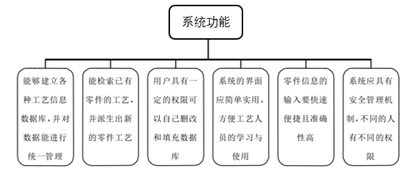
With the widespread application of CAPP, numerous examples have shown that implementing intelligent process design can bring significant benefits. In a detailed survey of 22 large and small companies using generative process design systems, adopting the system can reduce 58% of process planning work, 10% of labor, 4% of materials, 10% of waste, etc. Intelligent process design has gradually become a hot topic of research. The requirements of enterprises for the functions of intelligent process design systems are mainly concentrated in the following aspects, as shown in Figure 2.
Figure 2 Schematic diagram of the requirements of enterprises for the functions of intelligent process design systems
2) Analysis of Intelligent Process Design Model
Intelligent process design should further develop towards toolization, engineering, integration, networking, knowledge-based, intelligent, flexible, and standardized aspects, in order to lay a more solid and reliable foundation for enterprise information construction.
(1) Utilization and engineering. The intelligent process design system emphasizes toolization and engineering to improve the system's versatility in enterprises. Decompose the overall system into multiple relatively independent tools for development, conduct secondary system development for manufacturing and management environments, and integrate subsystems with various specialized functions on a unified platform.
(2) Integration and networking. The intelligent process design system realizes the comprehensive integration of CAD/CAE/CAM, and facilitates bidirectional information exchange and transmission of design data; Effective integration with production planning and scheduling systems; Establish an intrinsic connection with the quality control system. Realize comprehensive sharing of computing resources, storage resources, data resources, information resources, knowledge resources, and expert resources.
(3) Knowledgeable and intelligent. Based on the development and application of composite intelligent systems, expert systems, artificial neural network technology, and fuzzy reasoning technology, intelligent design systems can perform various levels of self-learning and adaptation, further transforming process design data into advanced manufacturing knowledge and achieving intelligent process design.
(4) Flexibility and standardization. Modern intelligent process design systems are based on interactive design and reflect flexible design; Based on the process knowledge base, achieve flexibility in process design and management for products; Taking the product as the core and the process route as the basis, arrange the process of process work according to the process route to achieve standardization of the design process.
(5) Interactive and progressive. Modern intelligent process design provides interactive input and output interfaces based on process knowledge and judgment for process designers, while also providing a visual management platform for enterprise management, gradually promoting the development process of intelligent manufacturing.
3 The Development and Evolution of Intelligent Process Design
The new generation of information technology is accelerating the development of intelligent manufacturing. The 3C electronics industry is facing challenges such as small batch and multiple varieties, rapid market changes, and large-scale customization, and must join the ranks of intelligent manufacturing innovation. Intelligent manufacturing is the current trend of development, and process design, as an important part of the manufacturing industry, directly connects product design and production. Implementing intelligent process design will greatly enhance the competitiveness of enterprises. The development of intelligent process design is based on the development of CAPP, gradually combining machine learning based artificial intelligence algorithms and digital twin technology to achieve the intelligence of process design, reduce or even eliminate the influence of human factors, and improve the efficiency and quality of process design.
1) The Development History of Intelligent Process Design Technology
The development of computer-aided process planning began in the late 1960s, as shown in Figure 3. Niebel first proposed the concept of CAPP in 1965. CAPP originated from the application of group technology (GT) in process design and is currently a component of computer-aided manufacturing and computer integrated manufacturing systems. With the development of mechanical manufacturing production technology and the demand for multi variety and small batch production in today's market, especially the development of CAD and CAM systems towards integration, networking, and visualization, computer-aided process planning is increasingly valued by people. Norway was the first country in the world to study CAPP, officially launching the world's first CAPP system AUTOPROS in 1969 and the commercialized AUTOPROS system in 1973. The CAM-I'S Automated Process Planning system, introduced by the international standardization organization CAM-I based in the United States in 1976, is a milestone in the development history of Computer Aided Process Planning. Taking its first letter, it is called the Computer Aided Process Planning system.
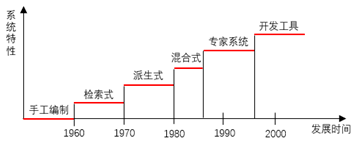
Figure 3 Development history of intelligent process design technology
The research on CAPP systems in China began in the late 1970s, with the earliest developed systems being Tongji University's TOJICAP revised system and Northwestern Polytechnical University's CAOS generative system. Representative systems developed later include Tsinghua University's THAPP system, Beihang University's EXCAPP system, Northwestern Polytechnical University's GNAPP system, and Nanjing University of Aeronautics and Astronautics' NHCAP system, all of which were completed in the early 1980s. So far, more than 50 CAPP systems have been published in domestic academic conferences and journals, but only a few have been officially applied by factories and enterprises, and there are not many truly commercialized CAPP systems.
Over the years, there has been a lot of exploration and research on the technology of Computer Aided Process Planning (CAPP) both domestically and internationally, and the implementation of the system has expanded from targeting specific parts such as rotors, boxes, and brackets in the early days to various categories of components. Expanding from local applications with components as the main body to comprehensive applications with the entire product as the object.
Since its emergence, the research and development of CAPP technology has been flourishing both domestically and internationally. However, due to technological limitations and personalized and diversified processes, the application scope of previous CAPP systems was relatively narrow, and could only be applied to a certain part of a certain enterprise, without a good universal solution. It was not until the emergence of tool based thinking at the end of the 20th century that a number of practical and commercialized CAPP systems emerged, which led to the substantial application stage of CAPP systems.
With the development of intelligent technology, in addition to traditional process planning problems, intelligent process systems for expressing knowledge in specific process problems, optimizing process decisions, and designing problems such as 3D simulation are gradually entering everyone's field of vision. However, despite these tremendous efforts, the task of process design is not yet fully automated and still relies on human experience and knowledge.
With the new generation of information technology endowing intelligent manufacturing with increasingly powerful cognitive and learning capabilities, the boundary between humans and machines has been greatly changed. The ideal intelligent process design system supports autonomous manufacturing through intelligent perception, simulation, understanding, prediction, optimization, and control strategies. It will be able to collect the experience and knowledge of technical experts, and can adapt and self learn based on real-time data and work history of the processing process. Embedding process planning into digital twin manufacturing units can not only enhance the connectivity between the upstream and design stages of the manufacturing unit, but also enhance the connectivity between the downstream of process planning and the manufacturing stage. With the development of intelligent process design research, the goals and technological means of intelligence are now different from before, focusing more on efficiency and real-time performance.
2) The evolution process of intelligent process design technology
Based on the development process of intelligent process design systems in China, intelligent process design has undergone the following evolution:
(1) A specialized system for process design based on automation ideas. For a considerable period of time since 1982, the initial intelligent process design system has been aimed at replacing the labor of process personnel to achieve process design automation, that is, a specialized intelligent process design system based on automation ideas. Emphasizing the automation of process decision-making, several types of Variant, Generative, and Hybrid CAPP systems have been developed, which can automatically or semi automatically prepare process specifications. The practicality and universality of this system are poor, which greatly limits its application and makes it difficult to achieve commercialization.
(2) A process design tool system based on the concept of process management. Since 1995, an intelligent process design tool system based on process management concepts has been developed. The system has made breakthrough progress in practicality, universality, and commercialization. The intelligent process design tool system, based on analyzing customer needs, aims to solve transactional and managerial work in process design. It can use computer-aided methods to automatically complete tedious and repetitive tasks such as data search, table filling, data calculation, and classification summary in process design.
(3) A comprehensive CAPP system and intelligent process system based on data management. Since 1999, there have been comprehensive process planning and intelligent process design systems based on process data for products. This type of system is an interactive computer application system that integrates process design and information management. It integrates mixed technology for process decision-making such as retrieval, revision, and creation, as well as artificial intelligence technology. It achieves human-machine hybrid intelligence, integration of people, technology, and management, and gradually realizes the automation of process design.
(4) Intelligent process design system based on real-time dynamic design. With the introduction of the digital twin concept in 2011, the design process of mechanical processing technology began to incorporate implementation models (As build)
model, The concept of the machining state model of workpieces is studied from the perspective of system construction in 3D process design technology for digital twin environments. A real-time process design method based on practical models is proposed, providing new ideas for process design based on digital twins. Real time decision-making and offline analysis optimization in the process design can be achieved, driving and leading the intelligent development of computer-aided process planning.
3) Development of Intelligent Process Design System
With the deepening demand for intelligent process design, intelligent process systems have also entered the field of researchers. Since the end of the 20th century, the development of intelligent process design systems has never stopped. It is the result of the application of artificial intelligence technology in the field of process design. At present, various types of intelligent process design systems have been developed.
(1) A CAPP system based on artificial neural networks. The most attractive feature of artificial neural network (ANN) technology is its self-learning ability and fault tolerance. Through sample training, ANN can automatically acquire knowledge; Through distributed storage and parallel processing of knowledge, ANN has strong fault tolerance, effectively compensating for the "narrow step effect" of expert systems. However, using ANN to simulate the process of process design decision-making also has fundamental flaws, such as the performance of ANN being largely limited by the selected training samples, and the quality of the samples directly determines the performance of the system; The knowledge expression and processing of ANN are implicit, and users can only see the input and output, without understanding the reasoning process in between. Therefore, for process design, ANN can only simulate some simple decision-making activities with direct corresponding (causal) relationships.
(2) Case based reasoning for a CAPP system. Case based reasoning for process planning (CAPP) technology is the application of analogical problem-solving methods in artificial intelligence technology, and can also be seen as a further development of derived CAPP technology. An instance is a comprehensive description of process design knowledge, which includes not only the solution results of the problem, but also the solution conditions of the problem. It has good consistency with the memory structure of human process design knowledge. Therefore, obtaining instance knowledge is much easier than obtaining rules. Instance based reasoning is the reuse of past solution results, rather than deriving from scratch, which has high efficiency and practicality in problem solving. Case based reasoning (CBR) technology has been extensively studied by many scholars.
(3) Knowledge based intelligent process system. The various knowledge expression and reasoning techniques of knowledge engineering greatly enrich and broaden the knowledge expression and processing capabilities of traditional generative process systems, enabling expert systems to handle some complex process decision-making problems, and some expert systems are close to practical use. However, with the continuous deepening of research and application, some inherent defects of traditional knowledge representation and reasoning techniques in expert systems have gradually been exposed, such as bottlenecks in knowledge acquisition, "narrow step effects" in system performance, and limitations in dealing with fuzzy, non monotonic, and common sense problems. Many early intelligent studies were based on expert systems, using computational module plugin formats as expert system tools in the process decision-making module. They combined rule-based knowledge representation languages with process prefixes, and then constructed knowledge bases using production rules. Deductive inference engines were used to theoretically achieve a series of process decisions. In fact, this only provided ideas for the early research on intelligent process systems. Based on the software and hardware conditions at that time, it did not involve artificial intelligence algorithms, nor did it build practical intelligent systems.
(4) Based on distributed artificial intelligence process design system. Most human activities involve social groups, and solving large and complex problems requires collaboration among multiple professionals or organizations. With the development of computer networks, computer communication, and parallel programming technologies, such technologies have gradually become a new research hotspot. At the beginning of the 21st century, process design represented by artificial intelligence technology has attracted increasing attention from researchers and may become an important breakthrough point for the development of the next generation of intelligent process design system software. Building a distributed intelligent process design system that includes a CAPP system and an intelligent process system can overcome the weaknesses of the original centralized knowledge system, greatly improve the system's performance, including problem-solving ability, solving efficiency, and reduce system complexity.
(5) The application of other intelligent technologies and algorithms. Fuzzy reasoning technology, evolutionary computing technology, particle computing theory, etc. have also been applied to varying degrees in process design. At the same time, the application of intelligent algorithms such as genetic algorithms and ant colony algorithms has played a positive role in expanding the information processing capabilities of intelligent process design systems and improving system performance. The digital twin technology of products continuously accumulates relevant data and knowledge throughout the entire life cycle of product design, manufacturing, and inspection, realizing the virtual real mapping of cyberspace and physical space, providing an effective way for the development of computer-aided process planning technology and the solution of bottleneck problems.
The above content comes from the official account: Zhizaoyuan, the author Xiaozhi. If there is infringement contact, delete it.
 Company Introduction
 Certification
 Patents &Technology
 Intelligent factory
 Intelligent Manufacturing Unit
 Intelligent Process Expert System
 Flexible Manufacturing System
 Vertical machining center production line
 Hybrid production line of CNC lathe and vertical machining center
 CNC lathe production line
 Machining process services
  Case Presentation
 Cooperative Partner
 Company News
 Industry News
 Contact information
 Recruitment
 Online Service






 Message

 Last
Last
